
Shelby County Supervision Types
Parole, post-release control, probation, and community control all permit a person to live outside a jail or prison while rules remain in force. They do not arise from the same record. The Ohio Department of Rehabilitation and Correction Offender Search covers people released from state prison under the Ohio Adult Parole Authority, or APA. Shelby County Adult Probation is an office of the Common Pleas Court. It supervises local felony cases and misdemeanors reduced from felonies through court-ordered community sanctions.
Parole follows release under an older-law or parole-eligible prison sentence. Post-release control, often shortened to PRC, is a term of APA supervision that begins after prison release for an eligible felony. Probation or community control is imposed by a court as a local sanction and may follow a jail term without an ODRC prison commitment. The source must match the case. An APA record does not replace the county jail release record, and Shelby Adult Probation does not hold state-prison release files.
| Supervision | Who imposes it | Where to verify |
|---|---|---|
| Parole | Ohio parole process after a parole-eligible prison term | ODRC Offender Search and parole records |
| Post-release control | Ohio law and the state-prison sentence | ODRC status, release detail, and APA fields |
| Probation or community control | Shelby County sentencing court | Court docket and Shelby Adult Probation |
- Discharge
- The formal end of a supervision term, which can occur well after physical release.
- Absconder
- A supervised person alleged to have stopped reporting or otherwise left supervision without authorization.
- Revocation
- A formal action that can return a person to custody after a proven violation.
Check Shelby County Post-Release Supervision
Start with the sentencing record, not a guess based on the charge. A Common Pleas docket can show whether the judge imposed prison, jail, or community control. A county bond release may occur while the case continues and may carry conditions, but that event is not parole. If prison was imposed, an ODRC record may show the later release and state supervision. If community control was imposed, the court docket and local probation office are the sound sources.
- Search the Shelby court record by name and case number. Read the sentencing judgment and later modification, revocation, or termination entries.
- If the sentence involved state prison, search ODRC by name or offender number and select the relevant status, including APA Supervision.
- Match the offender number, committing county, docket, offense, and sentence. Residential County is only a secondary filter because it reflects a last recorded address.
- Open the official detail and read the supervision start, supervision period, APA office, conditions, and Parole or Release Detail fields that appear.
- For local probation, verify the order through Common Pleas and contact Shelby Adult Probation about the official supervision record or office routing.
Not every ODRC field appears in every case. ODRC also warns that a supervision period may relate to an earlier offense and that sentence information can be incomplete. Compare the state result with the court docket before reaching a conclusion. The broader Shelby County release path, including the jail record and court confirmation, is covered on the released-inmate search page.
Note: Ask for the supervising office and public case record, not a person's private address or unverified location.
Shelby County Probation Office Details
Shelby County Adult Probation reports a small local staff made up of a chief and four probation officers. The office lists intensive and regular supervision, drug testing, counseling, community service, monitoring, and other court requirements among its functions. These services concern Common Pleas community-control cases. They are not APA parole services and do not establish when the Correctional Facility opened its door for a release.
Shelby County Adult Probation
Common Pleas Court supervision office
Phone: 937-498-7231
Monday through Thursday: 8 a.m. to 5 p.m.
Friday: 8 a.m. to noon
Use the office as a verification point only after checking the judgment. The research does not publish a separate street address for the probation office, so no address should be inferred from another county department. A caller can provide the case number and ask which public record reflects active supervision or successful discharge. Staff may limit what they disclose by phone.
Shelby County APA Release Records
State-prison supervision appears in ODRC, not in the Shelby jail roster. Search with minimal criteria first because surnames are prefix-based. Offender numbers carry a letter prefix and a six-digit number. County of Commitment identifies the prosecuting county. Residential County is available for APA or Violators at Large searches, yet ODRC says it is a last recorded address rather than a live location.
The detail may show status, supervision start, supervision period, the assigned APA office, conditions, and release or parole information. Ohio Revised Code Chapter 5149 establishes the Adult Parole Authority and its field and parole-board work. Current ORC 2967.28 governs post-release control, with terms that depend on offense and felony category. Avoid an old one-size duration summary. The current statute and the individual judgment control.
The successful manifest image below comes from the official ODRC definitions source and documents how Ohio labels released and supervised records.
View ODRC's status and release-date definitions before interpreting a result.
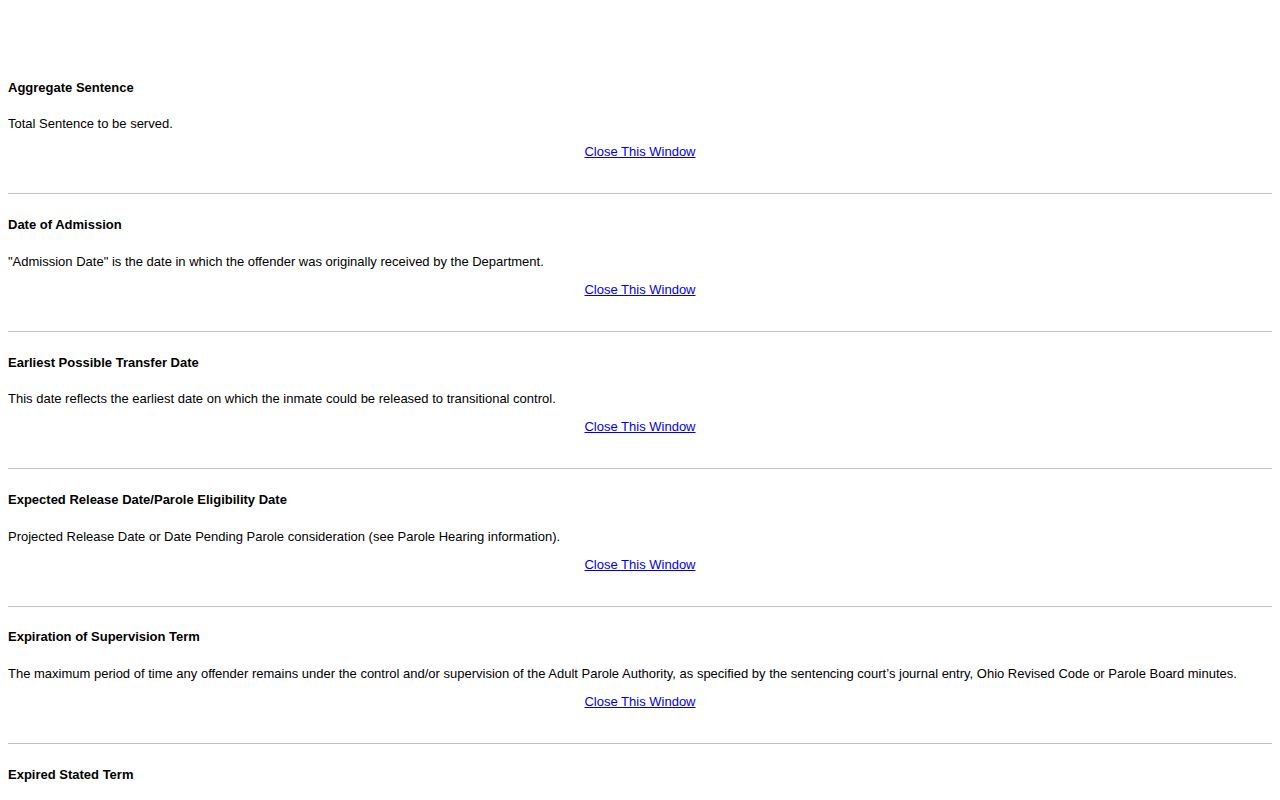
The definitions help separate incarceration, APA supervision, judicial release, and released status, but the court record still supplies the legal case history.
Shelby County Supervision Conditions
Supervision conditions are the rules attached to a particular release or court sentence. Shelby Adult Probation lists reporting, drug testing, counseling, community service, monitoring, payment duties, and compliance with court rules among its local work. An APA case can carry state conditions after prison release. The official judgment, ODRC detail, and supervising office determine which conditions apply. A general agency list should never be presented as one person's complete order.
A claimed violation does not itself prove revocation or new custody. The court docket can show a local violation filing, hearing, warrant, modification, revocation, or termination. ODRC may show a state supervision status, while a later jail record documents a new physical booking. These sources answer different parts of the event. Read them in date order and distinguish an allegation from a filed decision. Ohio VINE may send a participating custody-event notice, but it does not replace the court or APA record of the supervision issue.
Shelby County Absconder Record Layers
Two wanted-record layers can be relevant after release, and neither is a live jail roster. ODRC's Violators at Large filter identifies a person released from state prison who is alleged to have absconded APA supervision. It does not prove that the person is now confined in Shelby County. ODRC also cautions that the shown residential address is the last reported address. It should not be treated as a current location.
The Shelby County Sheriff's Most Wanted and tip page is a separate local warrant lead. A name on that page is not proof of post-release control, and absence from it does not prove there is no warrant. Law enforcement verifies warrant status through official systems. Members of the public should not attempt to apprehend a person based on either web result.
Important: A supervision violation, warrant lead, or last reported address is not a current custody finding. Confirm status with the responsible agency.
Shelby County Release Support Map
A state-supported Shelby Sequential Intercept Mapping report records local discharge-planning connections involving Shelby County Counseling Center, a local community-support organization, and the multi-county W.O.R.T.H. Center. It also identifies transportation as a system issue. Those details add local context to post-release planning, but the report is dated. It does not guarantee that a program is open, that a person qualifies, or that a bed or service is available.
Supervision agencies and support programs serve different roles. APA or Shelby Adult Probation can state the rules in an individual supervision record. A service provider decides its own eligibility and capacity. Court-ordered counseling, monitoring, community service, or treatment should be read from the judgment and official supervision instructions rather than inferred from a local program list.
Shelby County Supervision Discharge
Physical release and final discharge are separate milestones. Shelby Adult Probation says successful discharge requires payment of fines, costs, restitution, and drug costs, completion of counseling and community service, and compliance with the supervision rules. The controlling judgment and probation record show how those points apply in one case. A termination or discharge entry may appear long after the person left the county jail.
For APA cases, read the ODRC supervision period and release detail, then look for the official record showing release from supervision. A favorable parole decision is not the same as departure from prison. Holds, date calculation, program prerequisites, and institutional processing may still stand between the decision and release. Likewise, the start of post-release control shows that prison custody ended, not that all sentence duties ended.
Records of the end point also come from different offices. In a local case, read the chronological Common Pleas docket for a termination, successful discharge, revocation, or modification entry. In a state case, compare ODRC status and supervision fields with any parole-board or court action. If the public ODRC data appears incomplete, identify the offender number and contact ODRC Central Records at P.O. Box 430, Columbus, OH 43216. A county probation discharge should not be relabeled as an ODRC release, and an APA end date should not be presented as the earlier prison gate date.
Final discharge can affect later legal timing, including when a person may apply for relief under Ohio sealing law. It should never be calculated from the jail exit date alone. Use the current statute, the sentencing court, and the formal supervision record for that question.
Note: A court termination entry proves the legal act; it may not state the exact earlier time of physical jail release.